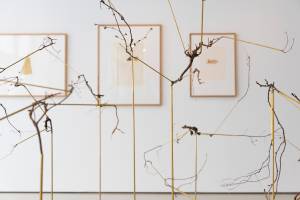
With the exhibition series Out of the Box, the ifa Galleries engage in a dialogue with the ifa art collection and reinterrogate it from contemporary perspectives. Action Bodies continues this artistic-curatorial exploration and focuses on the relationship between the body, sculpture and space, as well as on the question of how spaces can be shaped and experienced through movement and collective action. The exhibition gathers artworks that turn actions into material, make social orders visible and open up possibilities for resistance.
The hand thinks, the body answers. Franz Erhard Walther is a pioneer of participative art and an important point of reference for today’s generation of artists working in performance. He approached actions as an art form in themselves, changing the traditional idea of what an artwork can be. Since the early 1960s, Walther has created audience-activated textile sculptures, turning the viewers into participative actors. His first cycle of works brings together objects and processes, individuals and groups, elements of separation and connection. Ultimately, humans – their bodies and feelings in relation to language, site and the moment – are Walther’s sculptural material. His “action bodies” instruct us to explore space from standing, seated or reclining positions. Abstract sculptural terms such as (bodily) measurement, energy, space and time suddenly become physically accessible. Sketches and studies expand these experiences and concepts into dimensions both graphic and verbal.
In Four Exercises in Eshkol-Wachman Movement Notation, Sharon Lockhart illustrates the relationship between the body, movement and architecture. The video installation is part of a series of artworks dedicated to the life and legacy of dancer, choreographer and textile artist Noa Eshkol. In the 1950s, Eshkol developed an analytical-geometrical form of movement notation for the body. Like many artists at the time, she understood movement as a language in its own right and believed that dance emerged from this language. Lockhart examines this idea through film. Dancer Ruti Sela, a longtime student of Eshkol’s, moves her body forwards, backwards and sideways in minute gestures. She rotates her arms, her head tilted slightly to the side. Through these precise repetitions, the body becomes a carrier and reservoir of knowledge that perpetuates itself across time.
In the late 1970s, Wolfgang Laib’s artistic practice began interrogating our ways of being and acting within fragile natural habitats, making it highly relevant to the present day. His beeswax House opens up interior worlds. The concentrated adjacency of movement and stillness, the material and the immaterial, enduring and transient elements unfolds the liminal spaces where we reside.
Hana Miletić’s series Materials works with photographs documenting improvised repairs in public space, such as broken windows, doors or car parts patched up with tape. She translates these interventions into handwoven textiles. Miletić juxtaposes the conditions of our accelerated and standardised present with material craftwork. She thereby redirects the gaze onto the practice of repairing and reveals how acts of care can be inscribed in public space.
Social choreographies reflect embodied relationships and patterns in urban spaces. Eglė Budvytytė draws on these dynamics for a new choreography. The video Shaking Children is the product of a workshop with school children that explored shaking as a bodily gesture. For a moment, the children withdraw from the rhythms and rules of the school day. Their collective shaking becomes a symbolic exercise that destabilises established orders and invites viewers and participants to reconsider their bodies as sites of agency and resistance.
Silvi Naçi examines how exclusion, violence, migration, memory and debates around gender shape bodies and how they can liberate themselves. The film Actions That Make My Hands Hurt focuses on the chronic pain in Silvi’s hands, which is the result of their intensive training as a printmaker. Everyday hand gestures such as grasping, rotating or knocking are repeated. Invisible aches become an archive of gestures; corpora with their own gravity. The hands carry experiences of personal limitation into collective action and connection.
Tales Frey’s performances unfold through dance, sculpture and clothing. Following the beat of a metronome, his work Conductive Wire traces a series of flowing movements between two performers connected by textiles. Their shared body gives form to the space between people. Conductive Wire connects closeness and distance, freedom and limitation, balance and transformation to create a living hybrid figure.
Curated by Inka Gressel
Opening: 15.10.2026, 19:00
16.10.2026 – 31.01.2027